Results from eight years (2014–2021) of catches for the Integrated Monitoring of Songbird Populations (IMS) – Pohnsdorfer Stauung site
DOI:
https://doi.org/10.21248/corax.v26.51Abstract
In 1997 the three German Ornithological Stations started a monitoring project: Integrated Monitoring of Songbirdpopulations (IMS). In Schleswig-Holstein we are participating since 2014 in this project. At two sites in a reed bed of a silting area (Pohnsdorfer Stauung, Schleswig-Holstein: 54.24550 N, 10,23290 E), managed by the Schrobach-Stiftung, we are catching birds with mist nets (one 42 m and the other 24 m). Our site is one of around 70 places where the IMS is realized. Now we are presenting the first summarized evaltuation of the period 2014 to 2021. The birds are caught, identified, measured, weighed and ringed once a decade during the breeding months of May to August using a standardized method.
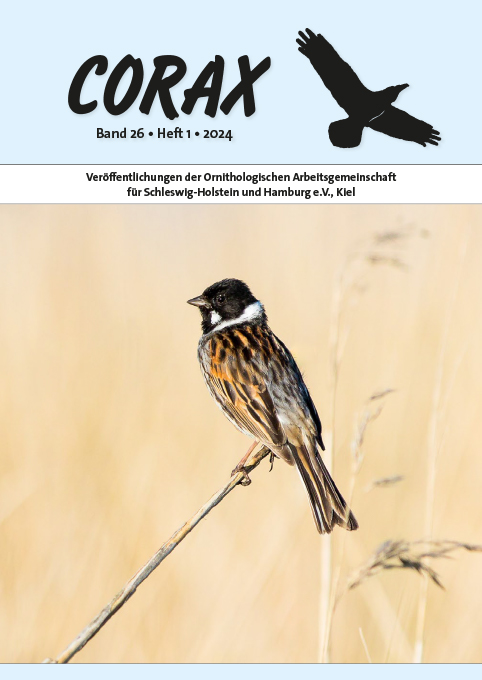
During our period we caught 2386 individuals belonging to 52 different species, of which 289 (12,1 %) already had been caught by ourselves, or in some cases, by other ornithologists. The European Reed Warbler Acrocephalus scirpaceus was the most common bird with 442 individuals (18,5 %) followed by the Marsh Warbler Acrocephalus palustris, Common Reed Bunting Emberiza schoeniclus and Bluethroat Luscinia svecica with each more than 200 birds. Overall nine species belonged to the groups of dominants and subdominants. The most successful year was 2014, after which the numbers decreased. After 2016, we have caught a relatively stable number of birds, with an average of 268 individuals per year. Presumably due to growing scrubs the number of birds caught declined at one trapping site since 2016, while it rised at the other site, so that the total has remained relatively constant.
Breeding success, measured by the proportion of this year’s birds in the total catch, varies from year to year for the dominant/subdominant species. Only single years can considered very (resp. less) successful. In 2014 several species were successful, while only very few species were successful in 2015 and 2016.
The most recaptures of (already ringed) individuals were recorded for the Reed Warbler. Almost every year at least one ringed bird was caught. The oldest Reed Warbler was at least five years old; one recapture came from a Danish ringing program. There was a sharp decline of Reed Bunting catches as well as for young Bluethroat. The other populations of dominant or subdominant species show fluctuations, but no clear trends.
We were able to recognize clear correlations between climate data and Marsh Warbler catch rates: higher average temperatures in summer and lower average summer percipitation had a positive effect on the proportion of catches this year. As both climate values correlated in opposite directions, it is not possible to decide whether individually increasing temperatures had a positive or increased precipitation a negative influence.
In one of our nets, fewer reed-adapted species were caught, but more scrub-adapted species and a higher diversity than in the other net. In both nets, the number of birds caught decreased slightly over time, as did the species-diversity. With our data, we were able to show the changes in bird life in the catchment area and make suggestions for the management of the area.
References
Bairlein, F., H.-G. Bauer & H. Dorsch 2000. Integriertes Monitoring von Singvogelpopulationen. Vogelwelt 121: 217–220.
Bauer, H.G., E. Bezzel & W. Fiedler 2005. Das Kompendium der Vögel Mitteleuropas. AULA-Verlag, Wiebelsheim.
Bräger, S. 2022. Wer früher geht, kommt auch wieder: Phänologie und Ortstreue norddeutscher Teichrohrsänger Acrocephalus scirpaceus. Corax 25: 1–16.
Elle, O., J. Engler, H. Lemke, N. Böhm, T. Mertes, M. Bötzel, T. Korschewsky, N. Thien & S. Twietmeyer 2014. Sieben Jahre Integriertes Monitoring von Singvogelpopulationen (IMS) im Untersuchungsgebiet ‚Trier-Brettenbachtal‘. Dendrocopos 41: 13–28.
Geiter, O. & F. Bairlein 2001. Richtlinien für ehrenamtliche Mitarbeiter. Institut für Vogelforschung. https://ifv-vogelwarte.de/fileadmin/resources/Beringerzentrale/Richtlinien/Richtlinien_gesamt.pdf. Abgerufen am 30.8.2024.
Geiter, O. & F. Bairlein 2013. Integriertes Monitoring von Singvogelpopulationen (IMS). Richtlinien für ehrenamtliche Mitarbeiter. https://ifv-vogelwarte.de/fileadmin/resources/Beringerzentrale/Richtlinien/Handbuch_4-1.pdf. Abgerufen am 20.11.2023.
Hennings, H. 1966. Die Wirtsvögel des Kuckucks (Cuculus c. canorus L.) in der weiteren Umgebung Hamburgs. Abhandlungen und Verhandlungen des Naturwiss. Vereins in Hamburg. Bd. XI: 123–170.
Kieckbusch, J., B. Hälterlein & B. Koop 2021. Die Brutvögel Schleswig-Holsteins. Rote Liste. Hrsg.: Landesamt für Landwirtschaft, Umwelt und ländliche Räume des Landes Schleswig-Holstein. Flintbek.
Köhler, W., G. Schachtel & P. Voleske 2007. Biostatistik. Springer Verlag, Berlin.
Meister, B., U. Köppen, O. Geiter, W. Fiedler & F. Bairlein 2016. Brutbestand, Bruterfolg und jährliche Überlebensrate von Kleinvogelarten – Ergebnisse des Integrierten Monitorings von Singvogelpopulationen in Deutschland (IMS) 1998 bis 2013. Vogelwarte 54: 90–108.
Meister, B., C. Herrmann, O. Geiter & W. Fiedler 2022. Integriertes Monitoring von Singvogelpopulationen (IMS) in Deutschland 2021. 26. Mitteilung. https://www.beringungszentrale-hiddensee.de/wp-content/uploads/2022/12/26.-IMS-Bericht.pdf (abgerufen am 10.10.2023).
Mitschke, A. 2022. Monitoring in der Normallandschaft. Bestandsentwicklung häufiger Brutvögel in Schleswig-Holstein. Ergebnisbericht, Saison 2021. Im Auftrag des Landesamtes für Landwirtschaft, Umwelt und ländliche Räume, Flintbek. https://www.oagsh.de/pdf/OAGSH_Monitoring_hBV_2021.pdf
Ostendorp, W. 1993. Schilf als Lebensraum. In: Landesamt für Umweltschutz, Baden-Württemberg (Hrsg.). Artenschutzsymposium Teichrohrsänger. Beihefte zu den Veröffentlichungen für Naturschutz und Landschaftspflege in Baden-Württemberg. Bd. 68: 173–281.
Saccavino, E., K. Jäckel & D. T. Tietze 2017. Wie gut repräsentieren die Ergebnisse des Integrierten Monitorings von Singvogelpopulationen die Population des jeweiligen Untersuchungsgebietes? Vogelwarte 55: 53–62.
Schwarz, L., K. Jäckel, S. Trautmann, E. M. Griebeler & D. T. Tietze 2015. Zehn Jahre Singvogelmonitoring am Eich-Gimbsheimer Altrhein. Fauna Flora Rheinland-Pfalz 13,(1): 173–200. http://www.dieterthomastietze.de/pub/2506.pdf
Wetterzentrale. Wetterdaten. https://www.wetterzentrale.de/weatherdata_de.php